

Table of Contents
🎯Key Takeaways
A lift chair is a powered recliner that tilts forward to help you stand safely at the touch of a button.
Lift chairs are medical devices in Canada, designed for mobility support—not just comfort.
They can help people with arthritis, balance issues, weakness, post-surgery recovery, Parkinson’s/MS, and circulation concerns.
The right chair fit matters most: seat height, depth, width, back height, and weight capacity affect comfort and safety.
Three-position chairs are a practical everyday choice for TV, reading, and napping with simple controls.
Infinite position (zero gravity) chairs offer the most flexibility (separate back/leg control, flatter recline, more therapeutic options).
Plan your space: most chairs need 12–18″ behind and 24–30″ in front.
With a prescription, many Canadians can buy a lift chair GST/HST exempt, saving 5–15% depending on province.
What Is a Lift Chair? (And Why It's Different from a Regular Recliner)
Standing up from your favourite chair shouldn’t be a struggle. If you find yourself using your arms to push off the armrests, asking for help to stand, or avoiding sitting down because getting back up is too difficult, you’re not alone. Thousands of Canadians face these challenges every day – and a lift chair might be exactly what you need to reclaim your independence.
But with dozens of models, confusing terminology, and prices ranging from about $1,000 to over $4,000, how do you know which lift chair is right for your home? This comprehensive guide walks you through everything you need to know to make the perfect choice.
A lift chair looks like a comfortable recliner, but it includes a powered lifting mechanism that gently tilts the entire chair forward, bringing you to a near-standing position at the touch of a button. This makes sitting down and standing up safer, easier, and completely independent.
Unlike standard recliners that are designed purely for relaxation, lift chairs are classified as medical devices in Canada. They’re specifically engineered to support people with:
- Arthritis or joint pain that makes movement difficult
- Limited mobility from aging, injury, or chronic conditions
- Balance issues that increase fall risk
- Post-surgery recovery requiring reduced strain on hips, knees, or back
- Muscle weakness from conditions like Parkinson’s or MS
- Circulation problems that benefit from elevated legs
The best part? With a prescription from your doctor, lift chairs qualify for GST/HST tax exemption in Canada, potentially saving you hundreds of dollars.
Still deciding between a lift chair and a regular recliner? Read Lift Chairs vs. Recliners: Which One Should You Choose?
Understanding the Three Types of Lift Chairs
Not all lift chairs are created equal. The type you choose depends on how you plan to use it and what level of comfort you need. Here’s what you need to know:
Two-Position Lift Chairs
These entry-level models recline to approximately 30-45 degrees – perfect for watching TV or reading, but not quite flat enough for sleeping.
Best for:
- Tight spaces (they require less clearance)
- People who primarily need help standing up
- Budget-conscious buyers
Keep in mind: Two-position chairs have largely been phased out in favour of more versatile three-position models, and we no longer carry them. If space isn’t an issue, consider upgrading to a three-position chair for better long-term value.
Three-Position Lift Chairs
A more popular choice among Canadians, three-position chairs recline back to a comfortable “napping position” where the backrest goes much further back than two-position models.
Best for:
- Daily use for TV watching, reading, and napping
- Seniors who want simple controls (just two arrows)
- Anyone seeking a good balance of features and affordability
Key feature: Three-position chairs use a single motor, meaning the backrest and legrest move together. When the back reclines, the legs come up—and vice versa.
Infinite Position Lift Chairs (Also Called Zero Gravity Lift Chairs)
These premium models offer the ultimate in customization and comfort. With dual motors, you can independently control the backrest and legrest to find your perfect position.
Best for:
- People who spend extended time in their chair
- Anyone with circulation issues (can elevate legs while keeping back upright)
- Those who want to sleep in their chair comfortably
- Users seeking therapeutic features like heat, massage, and lumbar support
Standout features:
- Fully flat sleeping position
- Trendelenburg position (feet elevated above heart for circulation)
- Independent power headrest and lumbar adjustments
- USB charging ports (on newer models)
- Heat and massage options
Worth noting: While infinite position chairs cost more upfront (typically $1,450 to $4,400), they offer significantly more versatility and therapeutic benefits for people who spend several hours daily in their chair.
Compare Lift Chair Types
Find the perfect lift chair for your needs and budget
✓
Included
⚠
Limited
✗
Not Available
Two-Position
Basic Lift & Recline
📐 Recline Angle
30-45°
🎯 Best For
TV, reading
⚙️ Motors
1
🎮 Independent Control
✗
📏 Wall Clearance
12-18"
🔥 Heat Therapy
✗
💆 Massage
✗
🧘 Zero Gravity
✗
🩺 Trendelenburg
✗
🎧 Power Headrest
✗
🔋 Power Lumbar
✗
📱 USB Ports
✗
😴 Sleep Comfort
★
★★★★
👤 Ideal User
Budget, small space
Not carried at Vital Mobility
Three-Position
Daily Use Comfort
📐 Recline Angle
60-75°
🎯 Best For
Daily use, napping
⚙️ Motors
1
🎮 Independent Control
✗
📏 Wall Clearance
12-18"
🔥 Heat Therapy
⚠ Limited
💆 Massage
⚠ Basic
🧘 Zero Gravity
✗
🩺 Trendelenburg
✗
🎧 Power Headrest
✗
🔋 Power Lumbar
⚠ Sometimes
📱 USB Ports
⚠ Sometimes
😴 Sleep Comfort
★★
★★★
👤 Ideal User
Daily users
$990 - $1,500 CAD
Infinite Position
Maximum Flexibility
📐 Recline Angle
180° (flat)
🎯 Best For
Sleep, extended use
⚙️ Motors
2-3
🎮 Independent Control
✓
📏 Wall Clearance
18-24"
🔥 Heat Therapy
✓ Full
💆 Massage
✓ Multi-zone
🧘 Zero Gravity
✓
🩺 Trendelenburg
✓
🎧 Power Headrest
✓
🔋 Power Lumbar
✓
📱 USB Ports
✓
😴 Sleep Comfort
★★★★★
👤 Ideal User
Medical needs
$1,450 - $4,400 CAD
| Feature | Two-Position | Three-Position | Infinite Position |
|---|---|---|---|
| Recline Angle | 30-45° | 60-75° | 180° (flat) |
| Best For | TV, reading | Daily use, napping | Sleep, extended use |
| Motors | 1 | 1 | 2-3 |
| Independent Control | ✗ | ✗ | ✓ |
| Heat Therapy | ✗ | ⚠ | ✓ |
| Massage | ✗ | ⚠ | ✓ |
| Zero Gravity | ✗ | ✗ | ✓ |
| Sleep Comfort |
★
★★★★
|
★★
★★★
|
★★★★★
|
| Price Range (CAD) | Not carried | $990-$1,500 | $1,450-$4,400 |
Ready to Find Your Perfect Lift Chair?
Browse our complete collection with expert guidance
Shop Lift ChairsThe 7 Critical Factors for Choosing Your Perfect Lift Chair
1. Size and Fit: The Most Important Decision
A lift chair that doesn’t fit properly won’t just be uncomfortable – it can actually be unsafe. Here’s how to get the measurements right:
Seat Height (Floor to Seat): While sitting normally, measure from the floor to the bend of your knee. Your feet should rest flat on the floor when seated. If the chair is too tall, your feet will dangle and you won’t get proper support. Too short, and the lift function won’t bring you high enough to stand easily.
Seat Width: Measure across your hips while sitting. Add 2-4 inches for comfort. Standard chairs accommodate 19-22 inches, while heavy-duty models offer 22-28 inches of seat width.
Seat Depth: Measure from your lower back to the back of your knee while sitting. The seat should support your thighs without pressure on the back of your knees.
Seat Back Height: Measure from your seated position to the top of your shoulders (or top of head if you prefer headrest support). Taller users need chairs with higher backs for proper support.
Weight Capacity: Choose a chair rated comfortably above your weight. Standard chairs support up to 300-375 lbs, while heavy-duty models hold up to 600 lbs. Building in a buffer ensures long-term durability and safety.
Pro tip: Sit in a few models before you buy. You can try lift chairs at our Concord and Toronto (North York) showrooms – please call ahead to make sure the model you want to see is on the floor. It’s the best way to get the fit right.
2. Space Requirements: Will It Actually Fit Your Room?
Lift chairs need clearance – both behind them and in front – to fully recline and lift.
Standard lift chairs require:
- 12-18 inches of clearance behind the chair
- 24-30 inches of space in front for the footrest and lifting position
Before you buy: Measure your intended space and compare it to the chair’s specifications. Pay attention to the “reclined length” measurement – this tells you how much floor space the chair occupies when fully extended.
Short on space? See our guide to the best lift chairs for small spaces.
3. Upholstery: Balancing Comfort, Durability, and Maintenance
Your fabric choice affects comfort, cleaning, and longevity.
Fabric options include:
Polyester/Microfiber:
- Soft, comfortable, breathable
- Good for people who tend to feel warm
- More challenging to clean spills
- Best for low-use environments
Vinyl/Faux Leather:
- Easy to wipe clean with damp cloth
- Durable and long-lasting
- Can feel sticky in warm weather or if you perspire
- Slightly slippery, which may affect stability when standing
Genuine Leather:
- Premium look and feel
- Very easy to clean
- Excellent durability
- More expensive
- Can be slippery for some users
Performance Fabrics:
- Stain-resistant and easy to clean
- Breathable and comfortable
- Good middle ground between fabric and vinyl
- Slightly more expensive than standard fabrics
Special consideration for incontinence: Many Canadian retailers offer specialized moisture-barrier fabrics designed for people managing incontinence. These protect the chair’s interior while remaining comfortable.
Custom upholstery: Some manufacturers offer custom fabric programs, allowing you to match your existing décor. Expect longer lead times (6-12 weeks) and additional costs.
4. Remote Control: Simpler Is Often Better
The remote controls your entire lift chair experience, so ease of use matters -especially for seniors or anyone with arthritis, vision problems, or cognitive challenges.
Control types:
Simple toggle controls (2-position and 3-position chairs): Just two buttons: one for up, one for down. Perfect for people who want straightforward operation with no confusion.
Multi-button remotes (infinite position chairs): Separate controls for back, legs, headrest, lumbar, heat, and massage. While more complex, these give you complete customization.
Backlit buttons: Essential for low-light use. Look for large, clearly labeled buttons with good contrast.
Pressure requirements: Some remotes require constant pressure (you hold the button down), while others are single-touch. For people with limited hand strength or arthritis, single-touch operation is much easier.
Battery backup: All quality lift chairs include battery backup so you can return the chair to the upright position during power outages. This is a critical safety feature – never buy a lift chair without it.
5. Position Options and Motors: More Isn't Always Better
Single motor (two-position and three-position): The backrest and legrest move together in a coordinated motion. This keeps controls simple but limits positioning flexibility.
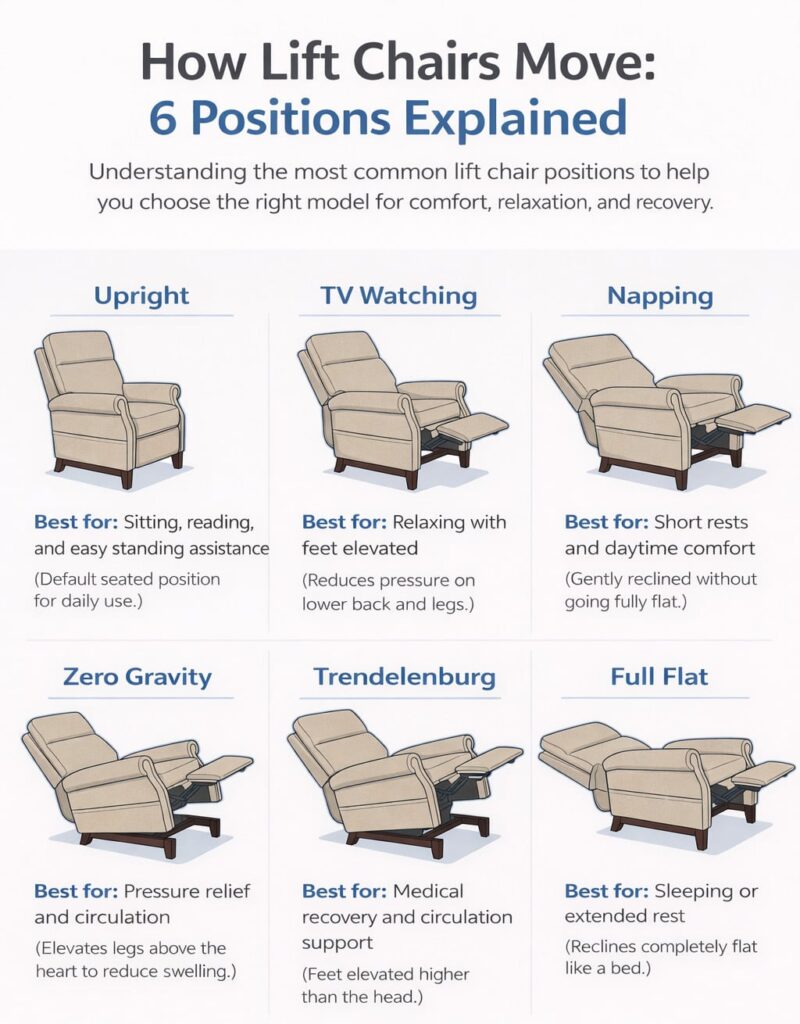
Dual motor (infinite position): Independent control of back and legs lets you find exact positions, like:
- Legs up while keeping back upright (ideal for circulation)
- Slight recline with legs down (comfortable for reading)
- Fully flat for sleeping
Additional motors may control:
- Power headrest (reduces neck strain)
- Power lumbar support (adjustable lower back support)
- Chaise/ottoman extension (adds leg support for taller users)
6. Therapeutic Features: Heat, Massage, and Health Benefits
Many modern lift chairs include therapeutic features that can significantly improve comfort and wellbeing:
Heat therapy: Gentle warmth in the seat and/or backrest can help relieve:
- Muscle tension and stiffness
- Arthritis pain
- Poor circulation
- General aches from sitting
Massage functions: Vibration massage in various zones (lumbar, full back, seat, legs) provides:
- Muscle relaxation
- Improved circulation
- Reduced tension and stress
- Comfort for extended sitting
Health positioning:
Zero Gravity Position: Distributes weight evenly, reducing pressure on the spine and improving circulation. This position is particularly beneficial for people with back pain or breathing difficulties.
Trendelenburg Position: Elevates the feet above the heart, promoting circulation and reducing swelling in legs and feet. Excellent for people with edema, diabetes-related circulation issues, or varicose veins.
7. Additional Features That Make a Difference
USB charging ports: Keep devices charged without leaving your chair (available on newer models)
Cup holders and storage pockets: Convenient for drinks, remotes, reading glasses, and medications
Extended footrests: Some chairs offer footrest extensions for taller users to ensure proper leg support
Swivel base: Makes it easier to get in and out of the chair, especially in tight spaces
Lockable controls: Prevents unintended use, useful in homes with children or for people with cognitive conditions
Top Lift Chair Brands Available in Canada
When investing in a lift chair, brand reputation matters. These manufacturers are trusted across Canada for quality, durability, and customer support:
Pride Mobility (Including VivaLift Series)
Known for innovative features like Trendelenburg positioning, power headrests, and modern designs. Pride’s infinite position models include lithium battery backup and USB ports. They feature 7 year warranties. Canadian pricing typically ranges from $1,000 to $4,400.
Golden Technologies
American-made chairs with exceptional build quality and long warranties. Golden offers everything from budget-friendly three-position chairs to premium and pricier infinite position models with heat and massage.
Understanding Costs: What Should You Expect to Pay?
Lift chair pricing in Canada varies based on features, size, and brand:
Budget-friendly ($990-$1,500): Basic three-position models with standard fabric, simple controls, and no therapeutic features. Good for occasional use or tight budgets.
Mid-range ($1,450-$3,000): Infinite position chairs with dual motors, heat and massage, power lumbar, and better upholstery options. Best value for daily users.
Premium ($3,000-$4,400): Top-tier infinite position models with all features: power headrest, extended footrests, Trendelenburg positioning, premium fabrics, and advanced massage systems. Ideal for people who spend significant time in their chair or need maximum therapeutic benefit.
Heavy-duty models: About $2,300-$3,000, with wider seats and weight capacities up to 600 lbs.
Can You Get Financial Assistance?
GST/HST Tax Exemption: Lift chairs qualify as medical devices and can be purchased tax-free in Canada with a written prescription from a physician, nurse practitioner, or occupational therapist. This saves you 5-15% depending on your province.
To claim the exemption:
- Get a prescription before purchase (presented at time of sale for immediate savings)
- Or apply for rebate after purchase using CRA Form GST189
Private insurance and extended health benefits: Many private health insurance plans and extended benefit programs offer partial reimbursement for lift chairs when prescribed for medical reasons. Coverage varies significantly – contact your provider before purchasing.
Veterans Affairs Canada: Veterans may be eligible for lift chair coverage through VAC programs. Contact your case manager for details.
Where to Buy: Online vs. In-Store
In-store advantages:
- Test multiple models for size and comfort
- Expert fitting and professional advice
- Immediate answers to questions
- See fabric and colour options in person
- Often includes white-glove delivery and setup
Online advantages:
- Sometimes lower prices
- Wider selection
- Shop from home
- Read customer reviews
Best approach: Visit a local showroom to test chairs and determine your ideal size and features, then purchase from a retailer offering the best combination of price, service, and delivery options.
At Vital Mobility, you can do both: try chairs at our Concord or Toronto (North York) showroom, or order online with shipping across Canada. Financing is available (buy now, pay later), and with a prescription we can sell your chair GST/HST-free.
Delivery and Setup: What to Expect
Here’s what to expect when you buy from Vital Mobility:
Delivery and setup in the Greater Toronto Area (fee applies):
- Delivery to room of choice
- Professional assembly and setup
- Removal of packaging
- Basic operation demonstration
- Well worth the additional cost for peace of mind
Canada-wide shipping: We ship lift chairs Canada-wide, with delivery times varying by location (typically 1-4 weeks for in-stock models)
Setup requirements:
- Nearby electrical outlet (most chairs use standard 120V)
- Adequate clearance (measure before delivery)
- Level floor surface for stability
Maintaining Your Lift Chair for Long-Term Performance
With proper care, a quality lift chair should provide 7-10 years of reliable service:
Daily care:
- Brush off debris and wipe spills immediately
- Avoid eating messy foods in the chair
- Keep remotes clean and dry
Weekly cleaning:
- Vacuum fabric surfaces with upholstery attachment
- Wipe vinyl/leather with damp cloth and mild soap
- Clean armrests and headrest areas
Monthly maintenance:
- Check all moving parts for smooth operation
- Inspect power cord for damage
- Test battery backup function
- Tighten any loose bolts or screws
Professional service: We service and repair the lift chairs we sell. Manufacturer warranties typically cover:
- Motor and mechanism (typically 2-3 years)
- Frame (often 5-7 years or lifetime)
- Fabric (1-2 years for wear and tear)
Common Questions About Lift Chairs
Can I sleep in a lift chair?
Infinite position chairs are designed for extended use including sleeping. However, three-position chairs may not recline far enough for comfortable overnight sleep.
Will my insurance cover a lift chair?
Some private insurance and extended health plans offer partial reimbursement. OHIP and provincial health plans typically don't cover lift chairs, but the GST/HST exemption provides tax savings.
How long do lift chairs last?
With proper care, expect 7-10 years for the mechanism and motor. Upholstery may need replacing sooner depending on use.
Can I use a lift chair after hip or knee surgery?
Yes - lift chairs are commonly recommended by surgeons and physical therapists for post-operative recovery. The powered lift function eliminates strain on healing joints.
Do lift chairs look like regular furniture?
Modern lift chairs are designed to blend into living spaces and often look just like traditional recliners, without a medical appearance.
What happens during a power outage?
All quality lift chairs include battery backup that allows you to return the chair to the upright position. The batteries automatically recharge when power is restored.
Are lift chairs safe for someone with dementia?
Yes, with precautions. Look for models with lockable remotes to prevent unsupervised use. The simple two-button controls on three-position chairs are easier for people with cognitive changes.
Making Your Final Decision
Choosing a lift chair is an investment in independence, comfort, and safety. Here’s your action plan:
Step 1: Determine your needs
- How many hours per day will you use it?
- Do you plan to sleep in it?
- Do you need therapeutic features (heat, massage)?
- What’s your space situation?
Step 2: Take measurements
- Your height, weight, and body measurements
- Your room dimensions and clearances
- Distance from nearest electrical outlet
Step 3: Set your budget
- Factor in tax exemption with prescription
- Consider long-term value vs. upfront cost
- Ask about financing options
Step 4: Visit a showroom
- Test different models for fit and comfort
- Try the controls
- Ask questions about warranties and service
- See fabric options in person
Step 5: Make your purchase
- Confirm delivery options and timeline
- Understand warranty coverage
- Schedule white-glove delivery if available
- Get prescription for tax exemption
Your Next Step
Finding the perfect lift chair doesn’t have to be overwhelming. With the right information and expert guidance, you can make a confident decision that improves your daily comfort and independence for years to come.
Ready to explore your options? Browse our lift chairs from trusted brands like Pride and Golden Technologies, visit our Concord or Toronto (North York) showroom (please call ahead), or call us at (905) 532-9494. With a prescription, you can buy your chair GST/HST-free. Whether you’re looking for a simple three-position chair or a fully-loaded infinite position model with all the bells and whistles, you’ll find options to fit every need and budget.
Your independence matters. The right lift chair can help you maintain it – safely, comfortably, and with dignity.
About the Author:

Find her on LinkedIn or email her at carolina@vitalmobility.ca